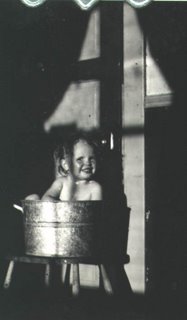
Vernon Edward Barber was born in a small drafty house in Nobleford, AB. He was brought into the world by my Aunt Theta acting as midwife. My Aunt and Uncle Oscar arranged to care for Mom during and after her pregnancy. Here's what Mom wrote about that event:
The weather was getting so cold that we moved my bed into the main room where the cook stove was, the only source of heat. On December 1, (1941), I woke up early in the morning and knew this was the day the baby would be born. I was very strong and had about four strong labour episodes, no pain, just the urge to push.
I had Theta take a look to see what was happening; she did and immediately started to gag. I don't think she had seen anything born before. I told her to quickly put Joyce's coat on and send her out to play, which she did. But then she ran and got Joyce's mitts from my room and on her way by my bed, she said, "Have I got time to put these mitts on her?" I said, "I don't think so." So she dropped the mitts on the floor, put out her hands and the baby plopped into them. She said, "It's a boy and he has the cutest little dink you ever saw." We didn't have the scales so I'm not sure of his weight but the first time we weighed him, a week later, he was 12 lbs. I'm guessing he was 9+ lbs. The baby was Vernon Edward and we called him Teddy until he went to school.
He was very well dressed. I had knit him sweaters and bonnets from wool I had unravelled from old sweaters and sock tops. His diapers were made of flour sacks, as were my maternity smocks. I sincerely hope I didn't steal any of them because I was a real scrounger. While working in Lanfine, I found a big box of rags in the attic among which was an old homemade quilt completely useless and falling apart. The inside of it was padded with old Stanfields underwear, men's size long johns. I took the woollen underwear out and washed it and made all the baby's little shirts out of it. It was beautiful stuff, pure wool and well-worn and as soft as silk. I had to cut around the holes but I had plenty of it. A newborn baby's undershirt doesn't need much material. If that was stealing, I'm really sorry because I didn't ask to use it. But today I do not have a bad conscience about it. I just marvel that I was able to put together a baby's wardrobe without spending a cent.
When Theta died, Mom wrote about their life together and this episode is from that writing.
Vernon was always a happy baby: he slept all night right from the beginning; he was good humoured and mild-mannered. He remained a well-adjusted child.
As he grew older, it was evident that he had inherited some of the traits of his father (manic depression) but he always remained the kindest person I ever knew.
(Back to Teddy)
Wednesday, January 10, 2007

Monday, January 08, 2007
Mom's Marriage and My Birth
There is a 20-year gap (from 1918 to 1938) in the pictures of my ancestors. That was the time when the Curtiss family was so poor that it could barely provide food and shelter let alone take photographs. Photos would have been such a luxury! During that time, Lizzie married Tom Moss and they began another family of four.
My mother was little more than a child when she began to sew in order to make her clothes and her surroundings beautiful. She embroidered small flowers on her homemade underwear so it would look nice! That was the beginning of her sewing career at which she excelled all her life. She made her own wedding dress and those of her sisters and her niece and probably others that I do not know about. She could create her own patterns and design and make anything.
My mother left home when she was fifteen and worked as a farm hand and/or house maid for other people. She and her brothers and sister sent money home for the younger children and their mother. They weren't always sure the money was used for sustaining the home.
So my mother was married on her 19th birthday in 1938. Her husband was Vernon Oliver Barber and he was about 9 years older than she was. He was the first man she ever kissed. Of course, it was important to her mother that Esther be a virgin on her wedding night. But the marriage came about mostly because my grandmother thought it was a good idea. I don't think my mother was "in love" with my father. The wedding night was a disaster and, as my Mom described it to me years later, it was a matter of "slam, bam, thank-you mam." Almost a year later, I was born and the top photo shows the three of us together.
My father was probably a manic-depressive or bi-polar as medical people refer to these things now. He was a ne-er-do-well: he couldn't hold down a permanent job; he had delusions of success which would make him expremely happy and then would have deep depression when his fanciful plans came to nothing. Physically, he was born with a club foot although I don't know whether or not he limped. He was enamoured of evangelical religion just as my grandmother was and I think that was the reason she pushed for the marriage. My father sometimes was an itinerant preacher, which must have really enamoured him to my grandmother who would seek such people out.
The marriage was attended by 19 people including Mom's sisters, Theta (a witness) and Ruth, their oldest brother, Daniel, and my grandmother, Helen Boyce Barber, and her husband, Jack J. Barber.
My Grandmother, Helen Barber, was a wonderful friend to my mother even after my mom divorced her son sometime after the birth of my brother in 1941.
(Back to Mom's Marriage)
My mother was little more than a child when she began to sew in order to make her clothes and her surroundings beautiful. She embroidered small flowers on her homemade underwear so it would look nice! That was the beginning of her sewing career at which she excelled all her life. She made her own wedding dress and those of her sisters and her niece and probably others that I do not know about. She could create her own patterns and design and make anything.
My mother left home when she was fifteen and worked as a farm hand and/or house maid for other people. She and her brothers and sister sent money home for the younger children and their mother. They weren't always sure the money was used for sustaining the home.
So my mother was married on her 19th birthday in 1938. Her husband was Vernon Oliver Barber and he was about 9 years older than she was. He was the first man she ever kissed. Of course, it was important to her mother that Esther be a virgin on her wedding night. But the marriage came about mostly because my grandmother thought it was a good idea. I don't think my mother was "in love" with my father. The wedding night was a disaster and, as my Mom described it to me years later, it was a matter of "slam, bam, thank-you mam." Almost a year later, I was born and the top photo shows the three of us together.
My father was probably a manic-depressive or bi-polar as medical people refer to these things now. He was a ne-er-do-well: he couldn't hold down a permanent job; he had delusions of success which would make him expremely happy and then would have deep depression when his fanciful plans came to nothing. Physically, he was born with a club foot although I don't know whether or not he limped. He was enamoured of evangelical religion just as my grandmother was and I think that was the reason she pushed for the marriage. My father sometimes was an itinerant preacher, which must have really enamoured him to my grandmother who would seek such people out.
The marriage was attended by 19 people including Mom's sisters, Theta (a witness) and Ruth, their oldest brother, Daniel, and my grandmother, Helen Boyce Barber, and her husband, Jack J. Barber.
My Grandmother, Helen Barber, was a wonderful friend to my mother even after my mom divorced her son sometime after the birth of my brother in 1941.
(Back to Mom's Marriage)
Sunday, January 07, 2007
Albert Boothe Curtiss (18??-1919)
So the Curtiss family that had just begun its collective life had to adapt to a hardscrabble existence without a father. They rapidly became "dirt poor" and must have had to leave their farm after trying to make a go of it with at least one hired man. I asked my mother if Lizzy had ever had any other relationships before she married for a second time and she said that she thought she had an affair with a hired man. That sounds plausible to me and makes her seem more human because she had a very strict moral code that she expected all her children to live by.
My mother was born on December 14, 1919. The death of my mother's father had profound effects on the immediate family and was carried down through the generations. I can imagaine how desperate it was to live during that first cold winter without a provider and with a newborn baby. Lizzy seemed lost for many years although she remarried later and had four more children, the first one being born in 1928 and the last one in 1933.
There are a few parallels in my mother's and my life: one of these is that we both grew up without a father. I have no idea how being fatherless affected our lives and relationships with others, but I'm sure it did.
(Back to Albert Boothe Curtiss)
My mother was born on December 14, 1919. The death of my mother's father had profound effects on the immediate family and was carried down through the generations. I can imagaine how desperate it was to live during that first cold winter without a provider and with a newborn baby. Lizzy seemed lost for many years although she remarried later and had four more children, the first one being born in 1928 and the last one in 1933.
There are a few parallels in my mother's and my life: one of these is that we both grew up without a father. I have no idea how being fatherless affected our lives and relationships with others, but I'm sure it did.
(Back to Albert Boothe Curtiss)
Saturday, January 06, 2007
Lizzie and Albert
Sometime before 1915, Elizabeth Orilla Graham met Albert Boothe Curtiss (whose father and mother came from Michigan to Alberta). They were probably married in 1915. They had a farm in Claresholm where their first children were all born at home with the help of a midwife. The first child, Daniel, was born in 1916; their second son, Ward, in 1917; the third child, Theta, was born in 1918. My grandmother was pregnant with her fourth child in 1919 and that girl was eventually to grow up and become my mother, Esther Mary. My grandmother looks quite contented in the photo and I think she was happily married.
It's hard to imagine that Albert never grew much older than what you see in the photo. Such a charming young man he must have been!
In October 1919 around Halloween, Albert climbed up the windmill to fix it and something hit him on the head and mortally wounded him. Elizabeth, seven and a half months pregnant, ran across fields to get help, but Albert died. So she was left with three children under four years of age and pregnant with another child. She must have been devastated to now have no one to support her financially or emotionally. I imagine that from that moment on she became more and more unstable and peculiar. She also sought out religion and depended on her beliefs to carry her through, often to the detriment of looking after her children.
(Back to Lizzie and Albert)
It's hard to imagine that Albert never grew much older than what you see in the photo. Such a charming young man he must have been!
In October 1919 around Halloween, Albert climbed up the windmill to fix it and something hit him on the head and mortally wounded him. Elizabeth, seven and a half months pregnant, ran across fields to get help, but Albert died. So she was left with three children under four years of age and pregnant with another child. She must have been devastated to now have no one to support her financially or emotionally. I imagine that from that moment on she became more and more unstable and peculiar. She also sought out religion and depended on her beliefs to carry her through, often to the detriment of looking after her children.
(Back to Lizzie and Albert)
Thursday, January 04, 2007
Viola Gladys
Viola Gladys Graham (1897-1989), the youngest daughter in the photograph was known as Auntie Gladys for years. She married Daniel Gallup and had two daughters. Daniel Gallup was an abusive spouse, emotionally and physically, a very malevolent person, and she put up with it for years. In those days, one just managed with what one had. He had to have one of his legs amputated but remained abusive nevertheless.
Auntie Gladys, however, was very kindly and greeted everyone with friendliness and appreciation. Her last years were her happiest and everyone missed her terribly when she died. You can see from the photograph her humour and joy.
(Back to Ancestors II)
Auntie Gladys, however, was very kindly and greeted everyone with friendliness and appreciation. Her last years were her happiest and everyone missed her terribly when she died. You can see from the photograph her humour and joy.
(Back to Ancestors II)

Wednesday, January 03, 2007
 Here is the photograph that I love so much of my mother (Esther Mary Curtiss) and my Great Grandmother (Mary Letitia Smith Graham). Obviously, the painting is my reference except that I did not paint in the busy flowers on the dresses and I picked some nice pink for the background and blue for the dresses (my favourite colours). The city is probably Calgary (or Edmonton) and I like the way these women are obviously enjoying each other's company. My mother looks to be in her twenties and her grandmother lived until 1949 or 1950 so I put the date at approximately 1945. It is too bad we couldn't blow up the license plate on one of the cars so we could see the date!
Grandmother Graham told my mother, in regards to her daughter Elizabeth ("Dizzy Lizzy"), that she didn't know what was wrong with that girl: "The day she was born she hauled off and gave me a dirty look!" So my mother's mother was a bit different from a very early age.
I may have met my Great Grandmother, but I was too young to remember it. I wish I had known her well.
(Back to My Mom and Great Grandmother)
Monday, January 01, 2007
 As I get older, I think more and more about where I came from. My memories going backwards stop with information about my maternal grandmother's family and to that end I have an old photograph which I obtained from my mother and which may have been given to her by an uncle or great uncle. I've dated it 1904 as my grandmother, who appears in the background, looks to be about 10 years old. My grandmother's name was Elizabeth Orilla and I was named after her and my paternal grandmother, Helen. However, I do not use either name although they both appear on my grave marker.
It's a funny thing, but the look on my grandmother's face is really the kind of person she was and remained throughout her life: sour, dissatisfied, mean and egotistical. The rest of the Graham family were more kindly. One of the brothers remained a bachelor all his life and I remember him coming to a family reunion while he was staying with my mother in Edmonton. He was undergoing radiation treatments for cancer and he didn't live long after that (the reunion was in 1964). As a child, I remember seeing his bachelor pad and thinking how sad it was that he slept on what appeared to be a round bench without a mattress or sheet. But memories sometimes play tricks on me although I know the emotion the memory elicits is genuine.
My great grandmother had at least 5 children, one of whom died in infancy. She was a very happy person, according to my mother. I have a picture of her and my mother walking down the street in Calgary wearing similarly flowered dresses. I love that picture.
My maternal great grandfather did not live to be an old man and I think he may have been difficult to live with. (Mom once told me the story of one of the grandmothers, either hers or mine, getting very angry at her husband for drinking and coming home drunk. He fell onto a rug by the doorway and grandmother rolled him up in the rug and beat the rug in anger at his drinking. I think William Anson may have been that grandfather, but the story is apocryphal.)
(Back to Art Blog)
Monday, October 09, 2006
Martha Marshall, who has been doing digital paintings, inspired me to try my hand at doing them also. If you wish to see some of her work go to http://artistsjournal.blogspot.com/2006/09/digital-study.html
(Back to Red and Green Symphony Digital Painting)
(Back to Red and Green Symphony Digital Painting)
Sunday, September 03, 2006
King's Landing
King's Landing is an historic site about 20 km from where I live. It is a replication of a large village of the 19th Century. All the workers wear period costume and horse and wagon is the only means of transportation (other than walking). This labour day weekend, the King's Landing people invited artists to attend up to three days in order to paint the buildings and scenery around the area. I applied and attended. I managed to do two paintings a day so far, and they are fairly reasonably done. The artists can display their work on easels for another few weeks until KL closes. I have one more painting day to go.
This kind of painting is what I have been doing all summer so it wasn't a real hardship. I found it quite easy to paint during the morning but a real chore to paint in the sun in the late afternoon and I tended to want to finish the painting very quickly.
I hope I sell one or two!
(Back to King's Landing 1)
(Back to King's Landing 2)
(Back to King's Landing 3)
(Back to King's Landing 4)
(Back to King's Landing 5)
(Back to King's Landing 6)
This kind of painting is what I have been doing all summer so it wasn't a real hardship. I found it quite easy to paint during the morning but a real chore to paint in the sun in the late afternoon and I tended to want to finish the painting very quickly.
I hope I sell one or two!
(Back to King's Landing 1)
(Back to King's Landing 2)
(Back to King's Landing 3)
(Back to King's Landing 4)
(Back to King's Landing 5)
(Back to King's Landing 6)
Wednesday, July 19, 2006
These pictures are a departure from my usual paintings. For six years, I have been walking and biking on the trail that was created from the old CP and CN Rail beds. There are all kinds of hardware in and beside the trail. Every spring more spikes and metal work their way up through the soil to the surface. I have been collecting these items for awhile and bringing them home to the studio until I could decide what to do with them. They are a lovely reddish colour both from the soil embedded on them and from the oxidization of the metal.
Here is one solution. I think these make beautiful paperweights and will display them as such. I have also used nylon thread to hang them from the ceiling in my studio as a kind of mobile. This is a project of fun for me!
(Back to Railway Spikes and Insects)
Here is one solution. I think these make beautiful paperweights and will display them as such. I have also used nylon thread to hang them from the ceiling in my studio as a kind of mobile. This is a project of fun for me!
(Back to Railway Spikes and Insects)
Thursday, July 13, 2006

I have done three acrylic paintings with a geometric theme. I saw an abstract painting done in this manner and wanted to try doing an object or a scene. It's fun to do if you don't mind the repetitiousness of painting triangles.
(Back to Geometric Wild Irises)

Saturday, June 10, 2006
This morning I sat beside the old house and gazed at the window I was going to paint. It was foggy so that my colours were hugely affected by all the moisture: I couldn't get a really dark grey and nothing wanted to dry. So I have this rather washed out looking painting. I didn't touch it up because I like to see the direct effects of weather on the results.
Mr. Brewer, whose uncle built this house, came by and we talked. He told me about the house; how he worked for the CP railroad and retired from it. (The trail I use was once the old rail bed.) Then he asked if he could buy one of my paintings! I was thrilled to say yes so if it is nice tomorrow, I will pedal down there with two matted paintings for him to choose from. Made my day.
(Back to Zealand House 9)
Mr. Brewer, whose uncle built this house, came by and we talked. He told me about the house; how he worked for the CP railroad and retired from it. (The trail I use was once the old rail bed.) Then he asked if he could buy one of my paintings! I was thrilled to say yes so if it is nice tomorrow, I will pedal down there with two matted paintings for him to choose from. Made my day.
(Back to Zealand House 9)
Monday, June 05, 2006
Today I did something I have never done before: I painted a watercolour painting based on an old oil painting. It is a portrait of my Zealand House completed last year. I didn't think it was very successful for various reasons. I've painted oil paintings based on watercolours a few times but never the reverse. What happened, I think, is that the details were not there for me to fiddle with and that is a good thing for the watercolour.
(Back to Zealand House 7)
(Back to Zealand House 7)
This morning I got up early and took the dog for a walk. Halfway around our walk as we were going up the Jones' Fork Road, we heard some galloping hoofs behind us. A large, young moose was coming up the highway at full tilt looking neither right nor left. He passed within feet of us and kept right on going as fast as possible. We were taken aback to say the least. I wonder if the insects were driving him/her crazy. Or it has been raining a lot the past two days and maybe that ruined his patch of ground where he grazes. It was exciting anyway and I worry that he will not be safe on our roads that have too much truck traffic. Still, it was a blessing to see one of these creatures. I have been noticing moose tracks in the woods and on the trail all winter long.
(Back to Sunset From the Front Deck)
(Back to Sunset From the Front Deck)
Thursday, June 01, 2006
I was attempting to do all plein air paintings during the challenge, but there are times when that is not possible. Today was one of those times. So I looked through my reference photos for an earlier picture of the same house when it still had a chimney showing.
One of my tasks is to learn to not depend too much on the photo when doing the painting. I notice that my edges become even sharper (if that is possible!) when working from a photo.
When I first painted this house a year or so ago, an old man came over to see what I was doing. He had lived in that house years ago. I never asked his name and regret that now as that would have given the house a name. Someone commented that the house looks full of ghosts. It does too.
(Back to Zealand House 5)
One of my tasks is to learn to not depend too much on the photo when doing the painting. I notice that my edges become even sharper (if that is possible!) when working from a photo.
When I first painted this house a year or so ago, an old man came over to see what I was doing. He had lived in that house years ago. I never asked his name and regret that now as that would have given the house a name. Someone commented that the house looks full of ghosts. It does too.
(Back to Zealand House 5)
Tuesday, May 30, 2006
I have started a project suggested by Martha Marshall--to paint 12 paintings on the same subject matter in order to help create a distinctive style given the same size paper, the same subject matter and the same palette.
I count this as my second painting. Today the insects were out in full force even though I left home earlier than usual hoping it would be too cool for them to bite in earnest. I also found that my paint was taking a long time to dry so I did a small painting while I was waiting. I seemed rushed, out of focus and bewildered by bites while doing this painting.
I did something else that I won't try again. I don't like to waste paint so I just added my new triad colours (Cobalt Blue, Aureolin, and Rose Madder (I don't know if it was "genuine") to the colours of the previous triad. A big mistake because the mixing was horrible. I couldn't get a grey I liked so everything is brown that should be grey. So I learned about sticking to three colours and not messing about in order to save paint!
(Back to Zealand House 2)
I count this as my second painting. Today the insects were out in full force even though I left home earlier than usual hoping it would be too cool for them to bite in earnest. I also found that my paint was taking a long time to dry so I did a small painting while I was waiting. I seemed rushed, out of focus and bewildered by bites while doing this painting.
I did something else that I won't try again. I don't like to waste paint so I just added my new triad colours (Cobalt Blue, Aureolin, and Rose Madder (I don't know if it was "genuine") to the colours of the previous triad. A big mistake because the mixing was horrible. I couldn't get a grey I liked so everything is brown that should be grey. So I learned about sticking to three colours and not messing about in order to save paint!
(Back to Zealand House 2)
Sunday, May 28, 2006
The no-see-'ums and mosquitoes were out in full force for the first time this year! I spilled my water all over everything (except my painting) and had to clean up. The painting fell into the sandy dirt and mixed some granules with the paint. But something else happened when I started to go faster because of the aforementioned incidents. I seem to have better values in this picture. I also think that because the building was not architecturally sound, I couldn't rely on what I knew the windows should look like so things are less stiff.
I am a painter of sharp edges, though, and need to work on those edges that disappear. First, I have to find a reason. That's next.
(Back to Zealand House)
I am a painter of sharp edges, though, and need to work on those edges that disappear. First, I have to find a reason. That's next.
(Back to Zealand House)
Wednesday, May 24, 2006
I've had my eye on these buildings for some time--the reddish/orange doors and frames caught my eye. The owners were kind enough to let me sit in the yard and paint this picture. The building that was formerly a house was turned into a stable. Apparently the shakes and the nails were hand turned on the house. The buildings are more than 80 years old but I don't know by how much.
There's a third barn on the site and that will be done at some time in the future.
I had to pedal 26 km for the round trip. My behind was very sore!
(Back to Williams' Old House and Barn)
There's a third barn on the site and that will be done at some time in the future.
I had to pedal 26 km for the round trip. My behind was very sore!
(Back to Williams' Old House and Barn)
Tuesday, May 23, 2006
This painting is one of two that I did from two different viewpoints. This separator was chained to a post beside a market stall that sold fruits and vegetables (in BC where my mother lived). The colours were gorgeous from the weathering and, of course, it brought back some memories of my teenage years.
When my brother and I were eleven and thirteen respectively, we went to Alberta to live with my aunt and to do the farm chores. We looked after many chickens, a few pigs, and milked about 8 cows twice a day. We fed all the animals, sometimes made churned butter, separated the milk from the cream, cleaned up everything (including sterializing the separator which is quite a job as there are lots of disks to clean between). We also did the inside work, emptying the honey buckets, cleaning, washing and waxing floors, liming and washing out the outhouse, pumping the water from the well and carrying in buckets of water by hand, washing and hanging out clothes, chopping and carrying in wood, etc., etc., etc. Anyway, it is a memory from a year's very hard work (for no pay!)
That's my nostagia with this piece.
(Back to Cream Separator)
When my brother and I were eleven and thirteen respectively, we went to Alberta to live with my aunt and to do the farm chores. We looked after many chickens, a few pigs, and milked about 8 cows twice a day. We fed all the animals, sometimes made churned butter, separated the milk from the cream, cleaned up everything (including sterializing the separator which is quite a job as there are lots of disks to clean between). We also did the inside work, emptying the honey buckets, cleaning, washing and waxing floors, liming and washing out the outhouse, pumping the water from the well and carrying in buckets of water by hand, washing and hanging out clothes, chopping and carrying in wood, etc., etc., etc. Anyway, it is a memory from a year's very hard work (for no pay!)
That's my nostagia with this piece.
(Back to Cream Separator)
Subscribe to:
Posts (Atom)